The technique of autologous chondrocyte transplantation flourished in the late 90s and was developed by PETERSON in 1994.
Already in large, specialized centers abroad, such as the Royal National Orthopaedic Hospital, Stanmore, in London, this technique has been in use for over 11 years, with very good results in a large number of patients.
Indications for ACM (autologous chondrocyte transplantation):
- symptomatic, localized, unilateral, full-thickness, cartilage damage of 2-10 cm2.
- extensive lesions in young individuals
- symptoms under 2 years of age
- athletes
- as a second operation after a previous one has failed.
The ACM method includes 2 stages.
- In the first stage, an initial arthroscopic assessment is performed which provides information regarding the morphological data of the cartilage damage (depth-extent) and at the same time a section of healthy cartilage is obtained from a non-load-bearing surface.
- In the second stage, the chondrocytes are implanted, then by laboratory culture and propagation, either by arthroscopic technique, or by small arthrotomy and periosteal retention techniques (1st generation), or other biological methods and materials (2nd generation). The 3rd generation of chondrocyte implantation is in the form of pellets, cultured in the laboratory, the adhesion of which is done arthroscopically, through the adhesive property of the specific pellets, at the level of the lesion.
Autologous Chondrocyte Transplantation
 |
|
 |
|
|
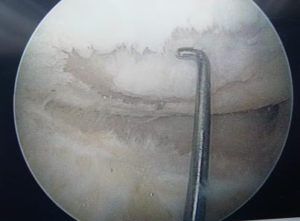
How does the lesion appear in arthroscopy
|
|
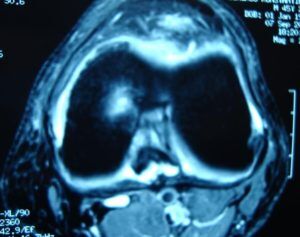
Image of the lesion in MRI
|
|
Contraindications for the application of the method:
- generalized osteoarthritis
- cruciate ligament ruptures
- previous meniscectomy
- flail-knee deformity
- mal-tracking
- knee inflammation
- arthrofibrosis
- neurological disease
- autoimmune disease
- morbid obesity
- pregnancy
- substance addiction
From a scientific point of view, the AMX has a comparative theoretical advantage in terms of creating better hyaline articular cartilage over time.
However, it is technically demanding, requires 2 surgical sessions and its cost is still high.
A necessary prerequisite for success is of course its application by an experienced and specially trained Orthopaedic Surgeon.
It also requires a continuous and long-term physiotherapy rehabilitation program.
The overall recovery program is completed in approximately 18 months.