
Knee replacement
Nikolaos Zervakis MD, MSc

AKnee arthroplasty is the invasive method used to replace a partial or total
joint of the knee that is suffering, mainly due to knee osteoarthritis and any other degenerative joint disease. In this case, the damaged articular cartilage of the thigh and shin is removed and replaced by special metal implants, made of materials compatible with the human body.
- Total Knee Arthroplasty
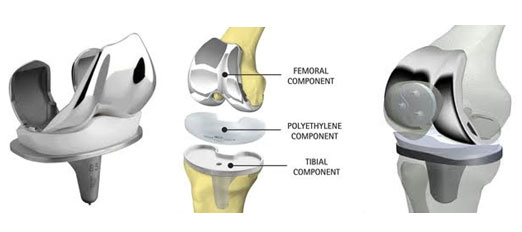
In the case of total arthroplasty, as much healthy bone as possible is preserved, which is particularly important in the event that a repeat arthroplasty is required in the future. Specifically, the affected joint is replaced with a metal prosthesis. The specialized orthopedic surgeon appropriately shapes the bones of the joint (femur, tibia, patella) and after correcting any axial deformations, fixes the metal parts of the artificial joint.
The metal prosthesis resembles the normal anatomy of the knee and functions as a normal joint. The artificial joint consists of special durable plastic (polyethylene) and very durable metal alloys of steel and titanium – completely compatible with the human body. As a technique, it is considered attractive especially in relation to a possible osteotomy, especially in women, because it does not create the slight angular deformation of the tibia.
- Unicompartmental Knee Arthroplasty
In case the damage is located in one part of the joint (single compartment), it is possible to apply unicompartmental knee arthroplasty. This technique is mainly applied to younger patients and patients with weight within normal limits
Compared to total knee arthroplasty, monocompartmental arthroplasty preserves the normal movement of the knee and allows for relatively easy conversion to total arthroplasty, if necessary over time. At the same time, with this method, the rehabilitation period is significantly reduced due to precisely this greater range of normal joint movement. See the restoration of mobility in a real case, with the method of total knee arthroplasty:
.
Knee Arthroplasty
Nikolaos Zervakis MD, MSc